
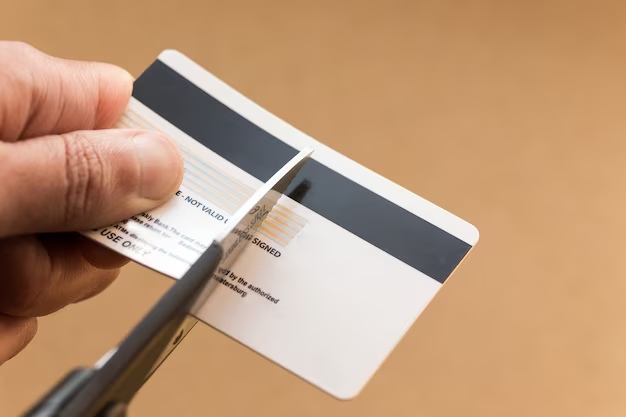
Your old card stays open unless you close it, but it becomes inactive once the balance moves
When you transfer a balance from one credit card to another, the original card does not automatically close. The card itself remains in your account, but the balance you moved is now zero. What happens next depends on what you do — you can leave it open, close it, or let it sit unused. Each choice affects your credit score differently, and understanding those differences helps you make the decision that fits your situation.
The card issuer does not force closure after a balance transfer. They would rather you keep the account open and active, because an open account means you might use it again and pay them interest or annual fees. So unless you explicitly request closure, the account stays on your credit report and in your wallet.
Key Takeaways
- Your old card remains open after a balance transfer unless you close it yourself, and the issuer will not close it automatically.
- Closing the card when ready after a transfer can lower your credit score because it reduces the total credit available to you and shortens your credit history.
- Leaving the card open with a zero balance helps your credit score by keeping your available credit high and showing a longer account history.
- If you keep the card open, use it occasionally for small purchases to prevent the issuer from closing it for inactivity.
- Watch for annual fees on the old card — if it has one and you are not using it, closing it may make financial sense despite the credit score impact.
Why closing the card right away usually hurts your credit score
Closing a credit card removes that account's available credit from your credit report. If your old card had a $5,000 limit, closing it means you lose $5,000 in available credit. Credit scoring models look at the ratio between the credit you use and the credit available to you — this is called your credit utilization ratio. When available credit shrinks, your utilization ratio goes up, and a higher ratio signals risk to lenders.
Closing the card also affects the age of your credit history. Credit scoring models reward accounts that have been open for a long time. If your old card was your oldest account, closing it removes that length from your history, which can lower your score. Even if it is not your oldest account, closing any card shortens the average age of your accounts.
The score drop from closing a card is usually temporary — it typically recovers within a few months as the account ages off your report. But if you are planning to explore for a mortgage, car loan, or other credit in the near term, closing the card right before that process can work against you.
Leaving the card open with a zero balance is usually better for your score
An open card with a zero balance improves your credit utilization ratio without any downside. If you have $10,000 in total credit limits across all your cards and you are using $2,000, your utilization is 20 percent. That same $2,000 in use across $15,000 in available credit (because you kept the old card open) drops your utilization to about 13 percent. Lower utilization looks better to credit scoring models.
The old card also continues to age on your credit report, which helps your credit history length. As long as the account remains open, it counts toward the average age of your accounts. This benefit grows over time — a card that is five years old helps your score more than a card that is one year old.
The trade-off is that you have to manage one more account. If you forget about the card entirely, the issuer might close it for inactivity after 12 to 24 months of no use. Some issuers are more aggressive about this than others. You can prevent closure by using the card occasionally — even a small purchase every few months is enough to keep it active.
Annual fees change the math
If your old card charges an annual fee and you are not using it, closing it makes financial sense even if it costs you a few points on your credit score. A $95 annual fee is real money, and paying it on a card you never touch is waste. In this case, the fee outweighs the credit score benefit of keeping the account open.
Before you close the card, check whether the issuer will waive the fee if you ask. Some card companies will remove the annual fee to keep you as a customer, especially if you have been with them for years. A quick call to the customer service number on the back of the card can save you the fee without closing the account.
If the issuer will not waive the fee and you do not plan to use the card, closing it is the right choice. The score impact is temporary, but the annual fee is permanent.
What to do if the issuer closes the card for inactivity
If you leave the card open but unused for too long, the issuer may close it on their own. This is not ideal because you lose the benefits of the open account without choosing to close it. The closed account stays on your credit report for seven years, but it no longer helps your utilization ratio or your account age in the same way an active account does.
If this happens, you cannot reopen the same account, but you can contact the issuer and ask them to reopen it. Some issuers will do this if you ask within a reasonable time frame — usually within 30 to 90 days of closure. Explain that you want to keep the account open and ask if they can reverse the closure. There is no harm in asking.
To prevent closure in the first place, put a small recurring charge on the card — a subscription service, a gas station purchase, or a coffee once a month. Charge it and pay it off when ready. This keeps the account active without costing you anything extra.
Keeping track of multiple cards
The more cards you keep open, the more accounts you have to monitor. You need to watch for fraud, track payment due dates, and remember to use each card occasionally if you want to keep it active. If managing multiple accounts feels overwhelming, it is okay to close some cards and accept the temporary credit score impact.
A practical approach is to keep your oldest card and your card with the highest limit open, and close the others if they have annual fees or if you genuinely will not use them. This gives you most of the credit score benefits of multiple accounts without the management burden.
If you do keep the old card open, set a phone reminder to use it every two or three months. This takes five minutes and prevents the issuer from closing it for inactivity. You can also set up a small automatic payment on the card — like a streaming service — and pay it off each month. This keeps the account active without requiring you to remember.
Frequently Asked Questions
Does closing my old card hurt my credit score when ready?
Yes, closing a card typically lowers your score within a few days because your available credit shrinks and your utilization ratio goes up. The drop is usually 10 to 50 points depending on how much credit you had on that card and how much you are using on your other cards. The impact is temporary and usually recovers within a few months.
Can I reopen a card after I close it?
You cannot reopen the exact same account, but you can explore for a new card from the same issuer. The new card will have a different account number and will be treated as a new account, so it will not have the age or history of the old one. If you think you might want to keep the card, it is better not to close it in the first place.
What if I have a $0 balance but the card still shows activity?
A zero balance is what matters for your credit score and your utilization ratio. Any small activity on the card — a charge you paid off, a pending transaction — does not change this. As long as the balance is zero when your statement closes, the card helps your score the same way.
How often do I need to use the old card to keep it open?
Most issuers will not close an account for inactivity unless it has been unused for 12 to 24 months. Using it once every few months is more than enough to keep it active. Even a single small purchase per quarter is sufficient to prevent closure.
Should I transfer the balance if I know I will close the old card?
If you are certain you will close the old card, the balance transfer still makes sense if the new card has a lower interest rate or a promotional period with no interest. The temporary credit score hit from closing the card is usually worth the savings on interest. Just try to avoid closing it when ready — wait a few months if you can.